

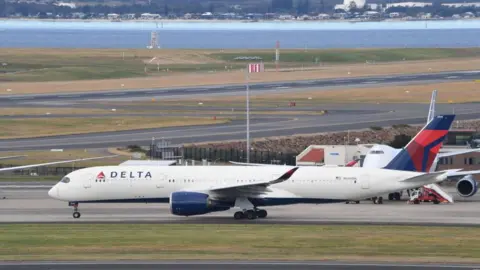
A number of individuals sustained injuries after a Delta Airlines jet originating in Los Angeles to Sydney was hit by significant turbulence Friday morning.
Flight DL41 "experienced a brief period of turbulence" as it landed at Sydney Airport, a company official stated. Several cabin crew members were injured.
The New South Wales Ambulance Service reported they evaluated five individuals, and transferred three of them to hospital with non-life-threatening injuries that such as spinal discomfort and migraines. Those affected were between their 30s up to the 70s.
The event represents the newest example of commercial jets experiencing atmospheric disturbance, with experts indicating that global warming is a major factor.
On board were nearly 250 travelers and fifteen staff members on the wide-body jet, the Delta spokesperson added, clarifying that the plane arrived "safely" at the airport at 06:48 local time on Friday.
The NSW Ambulance Service reported they received a call just three minutes prior to the plane touched down, and emergency vehicles were waiting on the tarmac.
The reasons turbulence is getting more frequent - and more severe.
During the past year, 25 people were hurt when a Delta Airlines flight, travelling from Salt Lake City, Utah to Amsterdam, Netherlands, encountered "significant" turbulence just two hours into the lengthy trip, and diverted for an unscheduled landing.
Recently, those on board on a Singapore Airlines jet endured a terrifying brief five-second of severe turbulence. One passenger passed away and numerous people sustained injuries, as individuals not fastened in were thrown from their seats and were slammed back.
Turbulence is fairly routine during flights, and while instances of strong or severe turbulence are reportedly becoming more frequent, they are remained quite uncommon.
Data suggests that there are around 5,000 incidents of significant in-flight disturbance annually, out of a sum of more than 35 million journeys that now take off worldwide.
Strong atmospheric disturbance is described as when the up and down movements of a plane going through rough air masses exert more than 1.5g-force on your body - sufficient force to throw you from your seat if you were not fastened by a restraint.
As a changing climate shifts the conditions in the sky, researchers alert that air travel could become less smooth: temperature changes and changing jet streams in the jet stream level are likely to heighten the frequency and intensity of dangerous in-flight bumps.


